What you’ll learn
- Locate proton pumping and ATP synthesis in a chloroplast.
- Track the carbon budget through GP, TP and RuBP.
- Explain limiting-factor evidence and the meaning of a practical measurement.
Connections: AQA 3.5.1 · OCR A 5.2.1. Core chloroplast reactions, carbon bookkeeping and selected data interpretation. These diagrams omit detailed photosystems and carrier sequences; use your board specification for the required depth of cyclic and non-cyclic photophosphorylation.
In this chapter
Inside a chloroplast
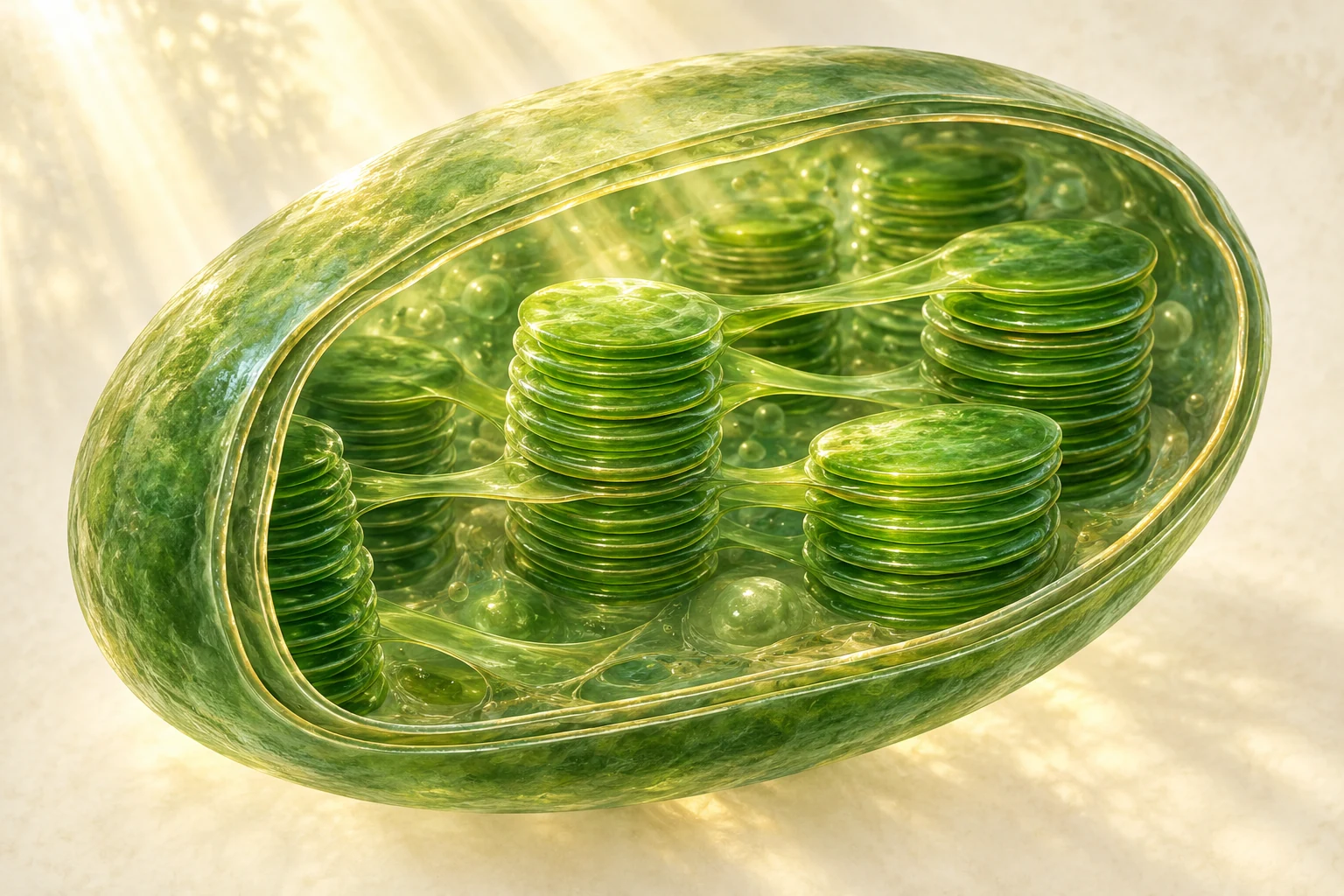
The chloroplast envelope surrounds the stroma. Thylakoids are internal membrane-bound sacs, often arranged in stacks called grana and connected by lamellae. Their membranes contain pigments and proteins involved in light-dependent reactions. The Calvin-cycle enzymes work in the stroma. A thylakoid lumen is the space inside a thylakoid, not another name for the stroma.
Chlorophyll and accessory pigments absorb different ranges of light. A pigment’s absorption spectrum concerns which wavelengths it absorbs; an action spectrum concerns the effectiveness of wavelengths in driving photosynthesis. A mixture of pigments can broaden light harvesting. Chloroplasts also contain DNA and ribosomes. These are not shown in the reaction diagrams.
Light-dependent reactions
Absorbed light excites electrons in photosystems. In non-cyclic flow, electrons originating from water pass through photosystem II, electron carriers and photosystem I before contributing to reduction of NADP. Water splitting replaces electrons lost by photosystem II and releases protons and oxygen. The balanced equation for photolysis is 2 H₂O → O₂ + 4 H⁺ + 4 e⁻.
Electron transfer supports movement of protons from the stroma into the thylakoid lumen. Water splitting also contributes protons to the lumen. Protons return down their electrochemical gradient through ATP synthase, supporting synthesis of ATP from ADP and inorganic phosphate on the stroma side. Cyclic electron flow associated with photosystem I supports ATP production without net production of reduced NADP or oxygen in that cyclic route.
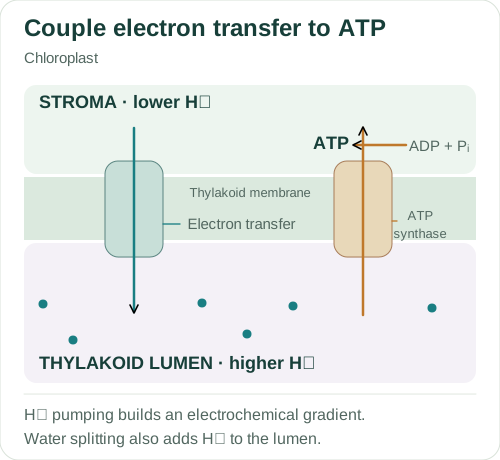
About this diagram
Selected coupling mechanism only. The full electron-transfer chain and detailed photosystems are not drawn.
The Calvin cycle
Rubisco catalyses fixation of carbon dioxide with five-carbon RuBP. The unstable six-carbon product gives two three-carbon GP molecules. ATP and reduced NADP from the light-dependent reactions support conversion of GP to TP. Some TP supplies carbohydrate synthesis and carbon skeletons for lipids and amino acids; most of it is used to regenerate RuBP so that fixation can continue.
For three CO₂ fixed, three RuBP molecules provide 15 carbon atoms and CO₂ adds three. Six GP and then six TP contain 18 carbon atoms. Five TP provide the 15 carbons needed to regenerate three RuBP, leaving one net three-carbon TP. Two net TP provide a six-carbon equivalent for carbohydrate synthesis. The Calvin cycle has no direct light-absorption step, hence “light-independent”. It still needs ATP and reduced NADP from the light-dependent reactions and is not restricted to darkness.
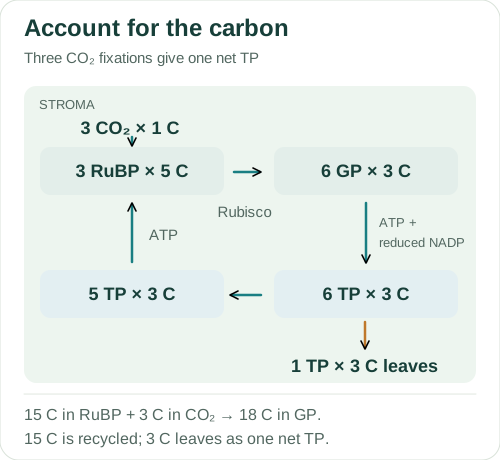
About this diagram
Carbon bookkeeping for three fixations, not three simultaneous collisions. GP = glycerate 3-phosphate; TP = triose phosphate. This map omits intermediates and ATP/coenzyme stoichiometry.
Limiting factors
At low light, increasing light intensity can raise photosynthetic rate. A later plateau can occur because another factor, such as carbon dioxide supply or temperature-dependent reactions, becomes limiting. A plateau alone does not identify which factor is responsible. Compare treatments in which a candidate limiting factor changes while the others remain comparable.
Water stress can cause stomatal closure, reducing carbon dioxide entry into the leaf. Very high temperature can affect enzymes and other processes, so the response is not an unlimited increase in rate. If light supply falls while fixation continues briefly, reduced conversion of GP to TP may initially increase GP and lower TP; longer-term concentrations depend on several interacting rates.
Measuring photosynthesis
Oxygen volume over time can estimate net oxygen production under the stated conditions; count of bubbles is a less direct measure because bubble sizes vary. Chloroplast extracts with DCPIP instead test light-driven reduction of an artificial electron acceptor. Reduced DCPIP loses colour. This assay does not directly measure sugar production by an intact plant.
An indicator-based algal assay responds to changes in carbon dioxide and pH. Photosynthesis and respiration both contribute to the result. Adding a carbon dioxide source may also change the indicator’s starting colour, making the comparison harder to interpret. If you propose a colorimeter, explain how it would measure the colour change more consistently. Replacing the assay with an oxygen measurement would change the method, not just improve its measurement.
Worked examples
1. Account for five net TP
Using the three-fixation bookkeeping diagram, determine how many CO₂ molecules must be fixed to obtain five net TP.
- Three CO₂ fixed give one net TP while RuBP is regenerated.
- Five net TP therefore require 5 × 3 CO₂.
- The five TP contain 5 × 3 = 15 carbon atoms.
Fifteen CO₂ molecules provide the 15 carbons in five net TP.
Five of the six TP molecules regenerate RuBP. Only the remaining TP counts as net product in this carbon budget.
2. Use a stated inverse-square model
A small lamp is moved from 20 cm to 40 cm. The question specifies intensity proportional to 1/d². Find the relative intensity.
- New/old intensity = (old distance/new distance)².
- (20/40)² = 0.25.
The model predicts one quarter of the previous intensity.
This is an assumed model, not a guarantee for every lamp or experimental arrangement. It predicts light intensity, not automatically a quarter of the photosynthetic rate.
3. Interpret two light-response curves
At the same temperature, added CO₂ raises the plateau rate at high light. At low light, the curves are similar. Explain.
- At low light, light-dependent supply constrains rate in the stated comparison.
- At high light, the higher plateau with added CO₂ supports CO₂ limitation in the original treatment.
- Adding CO₂ has little effect at low light, so the extra CO₂ cannot overcome the light limitation.
The comparison supports light limitation at the low-light end and a CO₂ limitation of the original high-light treatment.
A single plateau would not identify the limiting factor. The controlled comparison supplies the evidence.
These are original teaching examples, not reproduced exam questions or an official mark scheme.
Common errors
Photosynthetic oxygen comes from CO₂.
The oxygen released in the light-dependent reactions comes from water splitting.
All TP leaves the Calvin cycle.
Most TP in the bookkeeping account regenerates RuBP.
The Calvin cycle runs only at night.
It has no direct light-absorption step but depends on products of the light-dependent reactions.
DCPIP decolourisation proves a measured sugar yield.
It reports reduction of an artificial electron acceptor in that assay.
Check your understanding
Try the questions before opening the answers.
1. Where do protons accumulate during chloroplast chemiosmosis?
In the thylakoid lumen. Return to the stroma through ATP synthase supports ATP formation on the stroma side.
2. Why does stopping RuBP regeneration eventually reduce fixation?
Rubisco needs RuBP as the carbon acceptor. Without regeneration, the available pool is used up and further fixation declines.
3. Why can halving an assay’s endpoint time suggest a doubled relative rate?
For an equivalent fixed endpoint and comparable initial conditions, a rate index can be proportional to 1/time. The relationship must suit the assay; different endpoints cannot be compared this way.
Practice for this topic
- Rates and graph gradients
- Chromatography and Rf calculations
- Averages, spread and mitotic index
- Workbench: Chloroplasts: separate light from another variable
- Practical guide: Photosynthesis practical data
- Practical guide: Chromatography practical data
Connect this topic to an AQA essay title · Use official papers and mark schemes
Glossary
- GP
- Glycerate 3-phosphate, a three-carbon fixation product.
- TP
- Triose phosphate, a three-carbon product used in regeneration and biosynthesis.
- Reduced NADP
- NADPH; supplies reducing equivalents to the Calvin cycle.
References
References used for the explanations and diagrams, checked on 4 October 2026. The diagrams are schematics and are not to scale. Open “About this diagram” for the assumptions and details left out.