All prompts and explanations
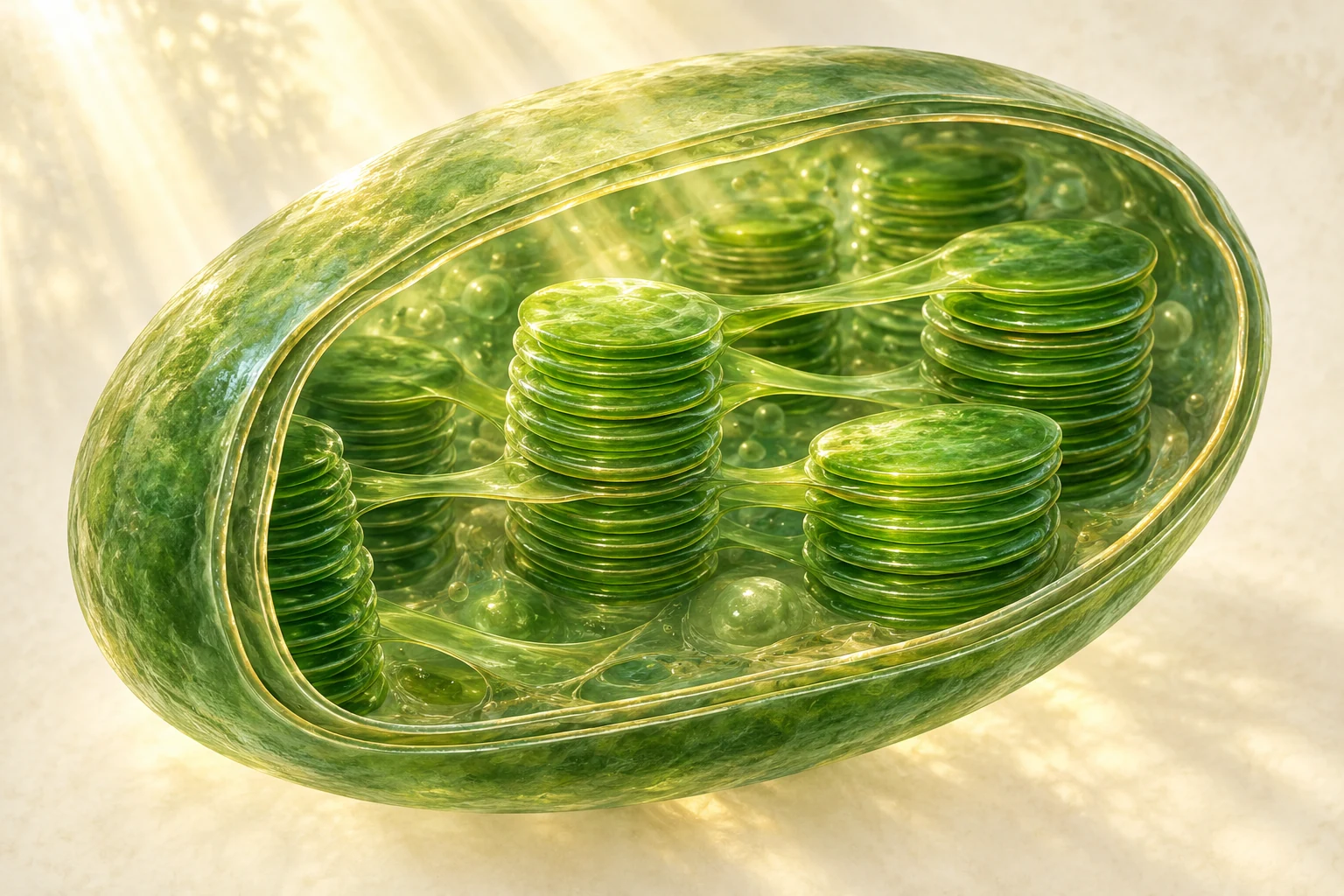
1. Where do the light-dependent reactions and Calvin cycle take place in a chloroplast?
The light-dependent reactions involve the thylakoid membranes. The Calvin cycle takes place in the stroma. The membrane arrangement supports electron transfer and a proton gradient, while stromal enzymes carry out carbon-fixation reactions.
2. What happens when a photosynthetic pigment absorbs suitable light?
Energy can excite electrons to a higher energy state. In a reaction centre, an excited electron can be transferred to an electron acceptor. Pigments differ in the wavelengths they absorb, broadening the usable light spectrum.
3. What are the products of photolysis of water?
Water splitting supplies electrons, protons and oxygen. Electrons replace those lost from photosystem II in non-cyclic electron flow. The oxygen released in this process comes from water, rather than from the carbon dioxide being fixed.
4. How is electron transport linked to a proton gradient?
Electron transfer through the thylakoid system is coupled to processes that build a proton gradient across the membrane. Water splitting also supplies protons on the lumen side. The gradient stores energy that can be used for ATP synthesis.
5. Explain chemiosmotic ATP production in the chloroplast.
Protons move down their electrochemical gradient through ATP synthase from the thylakoid lumen towards the stroma. This is coupled to ATP formation from ADP and inorganic phosphate. The membrane must maintain the gradient for this coupling to work.
6. What is the role of reduced NADP in photosynthesis?
It carries reducing power from the light-dependent reactions. In the Calvin cycle, it helps reduce glycerate 3-phosphate to triose phosphate, alongside energy supplied by ATP. Oxidised NADP can then be used again.
7. How does cyclic photophosphorylation differ in its immediate products?
Electrons from photosystem I return through an electron-transport route rather than reducing NADP. It supports ATP production without directly producing reduced NADP or oxygen. Oxygen release requires the water-splitting pathway.
8. What happens during carbon fixation in the Calvin cycle?
Carbon dioxide combines with the five-carbon acceptor RuBP in a reaction catalysed by Rubisco. The unstable six-carbon product forms two molecules of the three-carbon compound glycerate 3-phosphate. Carbon has entered organic molecules.
9. How is glycerate 3-phosphate converted to triose phosphate?
ATP supplies energy and reduced NADP supplies reducing power. Their use converts glycerate 3-phosphate into triose phosphate. These inputs link the Calvin cycle to the light-dependent reactions.
10. Why is most triose phosphate used to regenerate RuBP?
The cycle needs its carbon-dioxide acceptor to continue fixing carbon. Some triose phosphate can contribute to other organic molecules, but a substantial share is used in RuBP regeneration, which also requires ATP.
11. What does it mean for a factor to limit photosynthetic rate?
Under the current conditions, changing that factor can constrain or allow the rate. Increasing one factor may stop increasing rate when another becomes limiting. A plateau alone does not identify the new limiting factor without further evidence.
12. Does a decrease in DCPIP absorbance directly measure sugar production?
No. It records a change in the experimental electron-accepting dye and can indicate reducing activity under the assay conditions. Appropriate controls are needed. It does not directly count sugars made by an intact plant.
Original recall material. AQA specification · OCR A specification resources.