What you’ll learn
- Connect resting and action potentials to ion gradients and channels.
- Explain propagation, refractoriness and saltatory conduction.
- Follow a cholinergic synapse and decide whether a postsynaptic response reaches threshold.
Connections: AQA 3.6.1, 3.6.2 · OCR A 5.1.3. Selected sensory-to-neuronal signalling and cholinergic synapses. Detailed receptor structures, retina, plant responses, heart-rate control, neuromuscular junctions and muscle contraction need separate study.
In this chapter
Receptors and sensory pathways
A sensory receptor converts a stimulus into a change in electrical activity. In a mechanoreceptor, deformation affects membrane channels, changing ion movement and producing a generator potential. Its size can vary with stimulus strength. If depolarisation at the trigger region reaches threshold, action potentials can be generated.
A receptor potential and an action potential are different kinds of signal. A graded receptor potential can vary in amplitude; a propagated action potential has a stereotyped amplitude under the given conditions. Once threshold is reached, a stronger stimulus can increase impulse frequency or recruit more responding cells. It does not keep increasing each action potential’s amplitude under the same conditions.
In a reflex pathway, sensory neurones convey information towards the central nervous system and motor neurones carry output towards an effector. Relay neurones can connect them within the CNS, although not every reflex includes one between the sensory and motor neurone. Check the pathway shown in the question: a reflex may have a direct sensory-to-motor synapse.
Resting potential
A typical resting neurone has a negative potential inside relative to outside. The sodium–potassium pump uses ATP to move three sodium ions out and two potassium ions in per cycle, helping maintain their gradients. Selective membrane permeability, particularly potassium leak conductance in the basic model, makes a major contribution to the resting potential.
Resting does not mean all channels are closed or ions have stopped moving. Ion distributions and the membrane voltage influence each ion’s electrochemical gradient. Sodium concentration is normally greater outside and potassium concentration greater inside; when suitable channels open, their initial currents differ. The direction of movement depends on the electrochemical gradient, not just the ion’s charge.
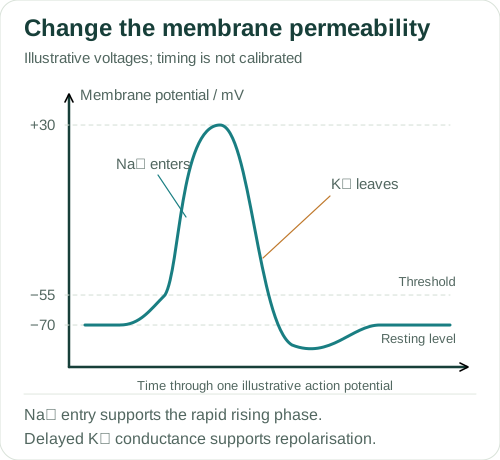
The illustrated −70 mV resting level and −55 mV threshold are typical teaching values, not fixed values for every neurone. Membrane potential is a difference between the two sides. A rise from −70 to −55 mV is depolarisation even though both values are negative.
The action potential
When depolarisation reaches threshold in the standard axon model, voltage-gated sodium channels open rapidly. Sodium entry causes further depolarisation, which opens more sodium channels: a regenerative positive-feedback process. The potential can become positive inside relative to outside during the rising phase.
Sodium-channel inactivation and increased potassium conductance limit the rise. Potassium moves out, repolarising the membrane. If potassium conductance remains elevated briefly, the potential can fall below its resting level, producing hyperpolarisation. Channel states then recover. The sodium–potassium pump maintains the underlying gradients over time; it is not the mechanism of the rapid falling phase.
During the absolute refractory period, recently activated sodium channels cannot immediately support another action potential. During a relative refractory period, a stronger stimulus may be needed as conductances recover. These periods limit firing frequency. The absolute refractory period also prevents immediate re-excitation of the region that has just fired.
About this diagram
Single typical schematic, not a measured trace or universal threshold. Voltage-gated sodium-channel inactivation and delayed potassium conductance are explained in the chapter. The sodium–potassium pump maintains gradients but is not drawn as the rapid repolarising mechanism.
Propagation and saltatory conduction
Current associated with an active region depolarises nearby membrane. If the next region reaches threshold, its channels generate a new action potential. The impulse is therefore regenerated; it is not one sodium ion travelling the length of the axon. The same physiological conditions give successive impulses broadly similar amplitudes.
Myelin reduces current leakage across covered membrane. In a myelinated axon, action potentials are regenerated at the nodes of Ranvier, where appropriate voltage-gated channels are concentrated. Current spreads between nodes, giving saltatory conduction and generally faster transmission than in a comparable unmyelinated axon. “Jumping” describes where regeneration occurs, not an ion crossing an empty gap.
Axon diameter, myelination and temperature can affect speed, but compare like conditions before assigning a cause. A distance divided by an observed latency estimates conduction speed only if the latency represents travel along that distance. A measurement that includes receptor processing or synaptic delay needs those contributions considered.
Cholinergic synapses
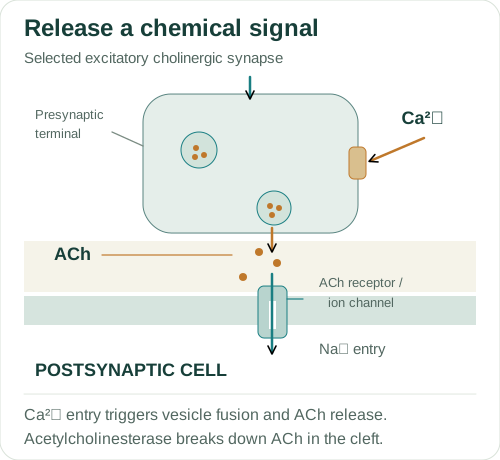
At this excitatory cholinergic synapse, an arriving action potential opens voltage-gated calcium channels in the presynaptic terminal. Calcium enters and triggers processes that allow vesicles to fuse with the presynaptic membrane. Acetylcholine (ACh) is released by exocytosis and diffuses across the synaptic cleft.
ACh binds to suitable receptors on the postsynaptic membrane. Here, increased cation conductance produces a net depolarising response; sodium entry is highlighted in the figure, although the channel also permits potassium movement. This local response is not automatically a propagated action potential. Its contribution must bring the appropriate trigger region to threshold.
Acetylcholinesterase breaks down ACh in the cleft, helping terminate the signal. Choline can be taken back up and used in resynthesis. The placement of release machinery on the presynaptic side and receptors on the postsynaptic side establishes the usual direction of transmission in this chemical synapse. Other synapses use other transmitters and can have different effects.
About this diagram
A selected excitatory cholinergic synapse, not every synapse. Calcium-channel gating and fusion machinery are simplified. Acetylcholinesterase is stated but not drawn. The receptor channel also passes potassium; sodium entry is highlighted for the depolarising effect. A postsynaptic response does not automatically reach action-potential threshold.
Temporal and spatial summation
Temporal summation occurs when successive inputs arrive closely enough that a later postsynaptic potential overlaps an earlier one. Spatial summation combines inputs from different synapses. Excitatory inputs can favour threshold attainment, while inhibitory inputs can reduce that likelihood through their effects on membrane conductance and potential.
The outcome depends on timing, location and the conductances involved. A simple arithmetic model can illustrate overlapping voltage changes, but real synaptic integration is not always linear. Use additive voltage changes only when the problem supplies that assumption. Reaching threshold triggers an action potential; further input does not give it a proportionally larger amplitude.
Worked examples
1. Describe a voltage change
An axon potential changes from −70 mV to −55 mV. Give the change and name its direction.
- Change = final − initial = −55 − (−70).
- The change is +15 mV.
- The inside becomes less negative relative to the outside.
This is a 15 mV depolarisation.
Negative starting values do not make the change negative. A threshold value indicates a condition for firing, not the maximum height of an impulse.
2. Calculate conduction speed
An impulse travels 0.18 m along a measured axon segment in 3.0 ms. Assume the timing excludes other delays.
- 3.0 ms = 0.0030 s.
- Speed = distance ÷ time.
- 0.18 ÷ 0.0030 = 60 m s⁻¹.
The estimated conduction speed is 60 m s⁻¹.
Convert milliseconds to seconds before dividing. The stated timing excludes synaptic and receptor delays, so the result estimates conduction along the axon segment.
3. Use a stated summation model
A simplified model starts at −70 mV with threshold −55 mV. Three overlapping excitatory inputs each contribute +6 mV at the trigger region. Assume additive changes.
- Two inputs give −70 + 12 = −58 mV, below threshold.
- Three give −70 + 18 = −52 mV in the supplied model.
- The combined depolarisation crosses the −55 mV threshold.
Three overlapping inputs are sufficient to trigger an action potential in this model; two are not.
The arithmetic concerns the trigger region before firing. It does not predict a larger action-potential amplitude, and the additive model is a simplification.
These are original teaching examples, not reproduced exam questions or an official mark scheme.
Common errors
The pump causes rapid repolarisation.
Sodium inactivation and potassium conductance explain the rapid falling phase; the pump maintains gradients over time.
A stronger stimulus makes each impulse taller.
Under the same conditions, strength is commonly encoded through frequency or recruitment.
An ion travels down the whole axon as the impulse.
Local currents and channel activation regenerate the electrical signal along the membrane.
Any transmitter release guarantees an action potential.
A postsynaptic response must contribute enough depolarisation at the relevant trigger region to reach threshold.
Check your understanding
Try the questions before opening the answers.
1. Why does opening sodium channels cause positive feedback during the rising phase?
Sodium entry depolarises the membrane, opening more voltage-gated sodium channels and allowing further inward current until channel inactivation and other conductances limit the process.
2. What must happen before ACh-containing vesicles fuse in this selected pathway?
The arriving impulse opens voltage-gated calcium channels, and calcium entry triggers the release processes.
3. Why is a refractory period relevant to frequency?
Recently active membrane needs time for channel states to recover before another impulse can be generated. This imposes a limit on how close successive impulses can be.
Practice for this topic
- Rates and graph gradients
- Units and standard form
- Practical guide: Animal movement and choice-chamber evidence
Connect this topic to an AQA essay title · Use official papers and mark schemes
Glossary
- Depolarisation
- A change making the membrane potential less negative, or more positive, inside relative to outside.
- Saltatory conduction
- Propagation with action-potential regeneration at nodes in a myelinated axon.
- Summation
- Combination of overlapping postsynaptic inputs in their effect on a cell.
References
References used for the explanations and diagrams, checked on 4 October 2026. The diagrams are schematics and are not to scale. Open “About this diagram” for the assumptions and details left out.