All prompts and explanations
1. How does a receptor connect a stimulus with nervous signalling?
A suitable stimulus changes the receptor’s membrane behaviour, producing a generator potential. If the relevant threshold is reached, action potentials can be generated in the sensory pathway. Receptors transduce stimulus information; they do not turn the stimulus itself into a neurotransmitter molecule.
2. What maintains a resting potential across a neurone membrane?
Unequal ion distributions and selective membrane permeability produce a potential difference. The sodium–potassium pump helps maintain concentration gradients, while channels allow particular ion movements. A resting membrane is dynamically maintained, rather than containing no ion movement or no metabolic activity.
3. Describe the main ion movements during an action potential.
Opening voltage-gated sodium channels permits sodium entry and depolarisation. Sodium-channel inactivation and increased potassium conductance allow potassium to leave and the membrane to repolarise. The changing permeability drives the rapid phases; the pump maintains gradients over time rather than directly causing each rapid repolarisation.
4. How can a nervous pathway encode a stronger stimulus if action potentials are all-or-nothing?
Above threshold, individual action potentials do not normally become proportionally larger with stimulus strength. Information can be represented by frequency and the recruitment of additional fibres. Distinguish action-potential amplitude from how many impulses or active pathways occur over time.
5. Why is the refractory period useful?
After an action potential, membrane-channel states temporarily prevent or reduce the chance of another one. This limits firing frequency and helps prevent immediate re-excitation of the region just activated. Together with local current flow, it supports forward propagation along a normally stimulated axon.
6. How does myelination increase conduction speed?
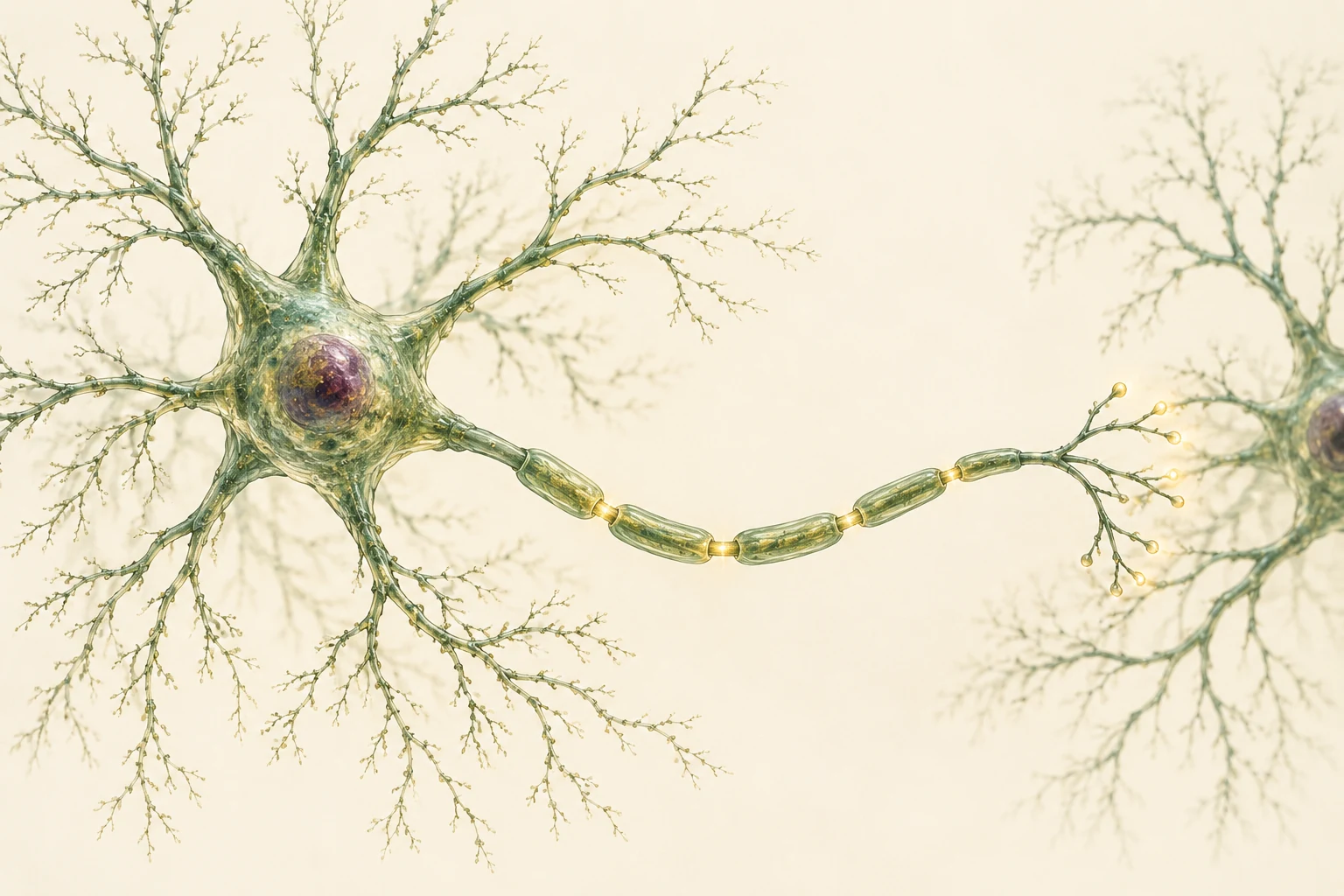
Myelin reduces ion movement across insulated regions, so local currents can spread to nodes where action potentials are regenerated. This saltatory conduction avoids regenerating an action potential at every point along the membrane. The impulse is not a particle physically jumping through the myelin.
7. Trace transmission at a chemical synapse.
An arriving action potential opens calcium channels in the presynaptic terminal. Calcium entry promotes vesicle fusion and neurotransmitter release. Transmitter diffuses across the cleft and binds postsynaptic receptors, changing membrane behaviour. The action potential itself does not cross the cleft as a continuous electrical event.
8. Why must neurotransmitter action be terminated at a synapse?
Removal, breakdown or uptake prevents a released transmitter from continuing to activate receptors indefinitely. The exact mechanism depends on the transmitter; acetylcholinesterase hydrolyses acetylcholine at cholinergic synapses. A fresh signal requires coordinated release and receptor activation rather than a permanently filled cleft.
9. How does a reflex pathway produce a rapid response?
A receptor and sensory pathway link a stimulus to a central nervous system circuit and then a motor pathway to an effector. Many reflexes involve relay neurones, but their circuits vary. The response can occur without conscious initiation, though the brain can still receive information about the event.
10. Distinguish taxis from kinesis.
Taxis is a directional response relative to a stimulus, such as movement towards or away from it. Kinesis changes activity, speed or turning in relation to stimulus intensity without specifying a directed heading. Unequal chamber occupancy alone does not establish which mechanism produced the distribution.
11. How does calcium allow actin and myosin interaction in skeletal muscle?
Calcium released within the muscle fibre binds troponin, changing the position of tropomyosin and exposing actin binding sites. Myosin heads can then form cross-bridges. Calcium permits the interaction through regulatory proteins; it does not itself shorten the actin filament.
12. Why is ATP needed for the cross-bridge cycle and relaxation?
ATP binding allows a myosin head to detach from actin, and ATP hydrolysis prepares the head for another cycle. ATP also supports calcium movement back into stores during relaxation. Thin and thick filaments slide relative to one another; they do not each become shorter.
Original recall material. AQA specification · OCR A specification resources.