What you’ll learn
- Distinguish broad defences from antigen-specific responses.
- Explain the roles of phagocytes, T cells, plasma cells and memory cells.
- Interpret antibody-response evidence and active or passive immunity.
Connections: AQA 3.2.4 · OCR A 4.1.1. Selected human defence, adaptive response and immune-memory mechanisms. Detailed pathogen examples, plant defences, HIV, monoclonal-antibody applications, drug development and wider disease prevention are not covered here.
In this chapter
Barriers and phagocytosis
Intact skin forms a physical barrier. Mucus can trap material in airways, and cilia help move the mucus towards the throat. These defences act before a specific lymphocyte response develops. A pathogen is an organism or agent capable of causing disease; an antigen is a molecular feature that can be recognised by the immune system.
If microbes enter tissues, innate responses can act rapidly. Phagocytes recognise patterns and other signals, surround material with their membrane and enclose it in a phagosome. Fusion with lysosomal compartments supplies conditions and enzymes for digestion. Engulfment by endocytosis is not the same event as diffusion across a membrane.
Some cells that take up antigen can present processed fragments with major histocompatibility complex (MHC) molecules. This makes material available for recognition by suitable T cells. Only T cells with suitable receptors can recognise a given antigen–MHC presentation, and activation requires the appropriate supporting signals.
Clonal selection and expansion
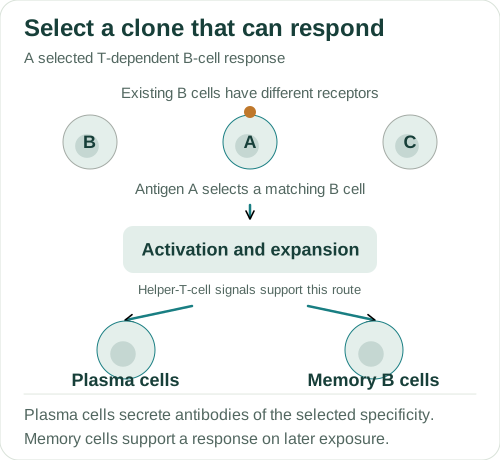
Before exposure, different B lymphocytes have different antigen-receptor specificities. An antigen binds to a B cell whose receptor has a suitable binding site. The antigen does not instruct an unrelated cell to invent a matching antibody. Activation and clonal expansion increase the population of cells descended from a selected responsive cell.
In a T-dependent response, a B cell can take up antigen, process it and present a fragment with MHC class II. A suitable helper T cell recognises the presented material and provides supporting signals. Activated B cells proliferate; some descendants become plasma cells that secrete antibodies, while memory cells persist and can participate in later responses.
These are three distinct events. Clonal selection identifies a cell with a suitable receptor; clonal expansion increases its numbers by cell division. Differentiation produces cells with specialised jobs, including antibody secretion. The diagram shows the main branches of this lineage, not measured proportions of plasma and memory cells.
About this diagram
Conceptual lineage, not cell morphology or fixed cell proportions. Receptor letters are specificity markers, not structures. Antigen binding is not presented as sufficient activation alone; this selected route includes helper-T-cell support. Antigen presentation and other activation signals are discussed in the chapter.
Helper and cytotoxic T cells
Helper T cells and cytotoxic T cells have different functions. CD4 helper T cells recognise antigen presented with MHC class II and support other immune cells through signals including cytokines. CD8 cytotoxic T cells recognise suitable antigen presented with MHC class I and can trigger the death of infected cells. T-cell receptors remain on the cell surface and recognise the antigen together with its presenting MHC molecule.
Killing an infected host cell can reduce the opportunity for an intracellular pathogen to reproduce. An antibody in the extracellular fluid has a different route of action. A coordinated response can use both mechanisms, so a question about a virus needs you to establish whether it concerns particles outside cells, infected cells or both. Memory can involve T cells as well as B cells.
How antibodies act
An antibody is an immunoglobulin protein. Its variable regions form binding sites with chemical properties complementary to a particular antigenic site. Binding can neutralise a toxin, block a pathogen’s attachment site or coat a particle so that phagocytes recognise it more readily.
Antibodies with more than one binding site can link antigen-bearing particles, producing agglutination. This can assist their removal. Antibodies do not engulf pathogens and are not cells. Plasma cells produce and secrete them; phagocytes perform uptake and digestion. If a question asks how an antibody helps destroy bacteria, follow the binding with the resulting agglutination or phagocytosis.
Primary and secondary responses
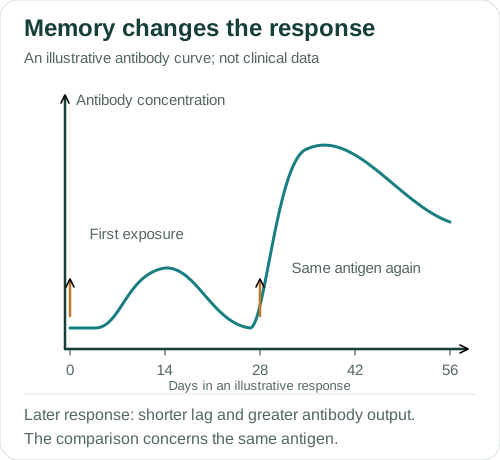
A first adaptive response takes time because suitable cells must be activated, proliferate and differentiate. On later exposure to the same antigen, memory cells can support a response with a shorter lag and greater antibody output. Compare the time from each exposure, not the absolute day on the graph. The schematic illustrates the relationship and is not a clinical prediction of timing or protection.
Active immunity follows an individual’s own immune response. Vaccination can present antigen in a form intended to establish protective responses and memory without the corresponding natural infection. Passive immunity supplies antibodies made elsewhere. Those antibodies can act immediately but do not themselves create the recipient’s antigen-specific memory; they are eventually broken down.
A response curve is evidence of antibody production under the conditions tested. Its shape alone does not establish that every antibody is protective or that protection lasts indefinitely. Antigen differences, immune context and the measurements available all affect what can be concluded. Check what the assay measured and whether both exposures involved the same antigen.
About this diagram
Illustrative shape and time axis, not patient data or a guaranteed duration of protection. Response magnitude and persistence vary with antigen and immune context. The vertical axis has no numerical units.
Worked examples
1. Neutralising a toxin
A toxin causes damage by binding to a receptor on a host cell. An antibody binds over the toxin’s receptor-binding region. Explain the protective mechanism.
- The antibody binds to the toxin’s receptor-binding region.
- The bound antibody obstructs attachment to the host-cell receptor.
- Fewer toxin molecules can attach, reducing their opportunity to act.
The antibody can neutralise the toxin by blocking its attachment to the host-cell receptor, reducing the toxin’s opportunity to act.
The antibody blocks the toxin’s attachment. Digestion of the toxin is not needed for this protective effect.
2. Compare response lags
In an illustrative study, exposure occurs on day 0 and the measured antibody rise begins on day 8. A second exposure is on day 40 and its rise begins on day 43. Calculate the two lags.
- First lag = 8 − 0 = 8 days.
- Second lag = 43 − 40 = 3 days.
- Difference = 8 − 3 = 5 days.
The lags are eight and three days; the later lag is five days shorter.
Memory provides a biological explanation consistent with a same-antigen response. The timing alone does not count memory cells or establish how long protection will persist.
3. Distinguish supplied antibody from memory
A recipient receives a preparation of antibodies and shows immediate antigen-binding activity. No recipient-produced memory response is demonstrated. Classify the immunity described.
- The effective molecules were produced elsewhere and supplied to the recipient.
- Their immediate availability does not require recipient clonal expansion.
- There is no evidence here of recipient memory formation.
The described protection is passive immunity; the supplied antibodies do not themselves establish the recipient’s memory.
Active immunity involves the recipient’s own response. Passive immunity supplies antibodies made elsewhere. Either can result from a deliberate intervention.
These are original teaching examples, not reproduced exam questions or an official mark scheme.
Common errors
Antigen and pathogen mean the same thing.
An antigen is a recognised molecular feature; a pathogen is a disease-causing organism or agent.
The antigen designs a matching antibody.
Recognition selects from existing lymphocyte receptor specificities.
All T cells make antibodies.
Plasma cells of the B-cell lineage secrete antibodies; T cells have other response roles.
Passive immunity necessarily creates memory.
Transferred antibodies provide activity while present; they do not themselves create recipient memory.
Check your understanding
Try the questions before opening the answers.
1. Why does a larger clone help a response?
More descendants with the selected specificity are available. Differentiated plasma cells can produce more antibody in total, while other descendants contribute memory.
2. Why can extracellular antibodies and cytotoxic T cells both be relevant to a virus?
Antibodies can act on accessible viral antigens outside cells, for example by blocking attachment. Cytotoxic T cells can act on infected cells presenting suitable antigen with MHC class I.
3. What needs aligning before comparing two antibody-response curves?
Align the time of exposure, identify whether the antigen is the same, and compare measurements using the same concentration scale and assay conditions.
Practice for this topic
- Averages, spread and mitotic index
- Statistical tests and conclusions
- Practical guide: Antimicrobial investigations: interpreting evidence
Connect this topic to an AQA essay title · Use official papers and mark schemes
Glossary
- Clonal selection
- Selection of a lymphocyte specificity able to respond to an antigen.
- Plasma cell
- Differentiated B-lineage cell that secretes antibodies.
- Memory cell
- Persistent antigen-experienced lymphocyte able to contribute to a later response.
References
References used for the explanations and diagrams, checked on 4 October 2026. The diagrams are schematics and are not to scale. Open “About this diagram” for the assumptions and details left out.