All prompts and explanations
1. How do physical and chemical barriers contribute to defence?
Skin and epithelial surfaces limit pathogen entry. Mucus can trap particles, cilia can help move mucus, and some secretions contain antimicrobial components. These defences act before or alongside specific immune responses; they do not require prior recognition of one particular antigen.
2. What is an antigen in the context of an immune response?
It is a structure that can be recognised by components such as antibodies or lymphocyte receptors. Antigens may be associated with pathogens, cells or other material. Recognition depends on molecular fit; an antigen is not synonymous with an antibody or with an entire pathogen.
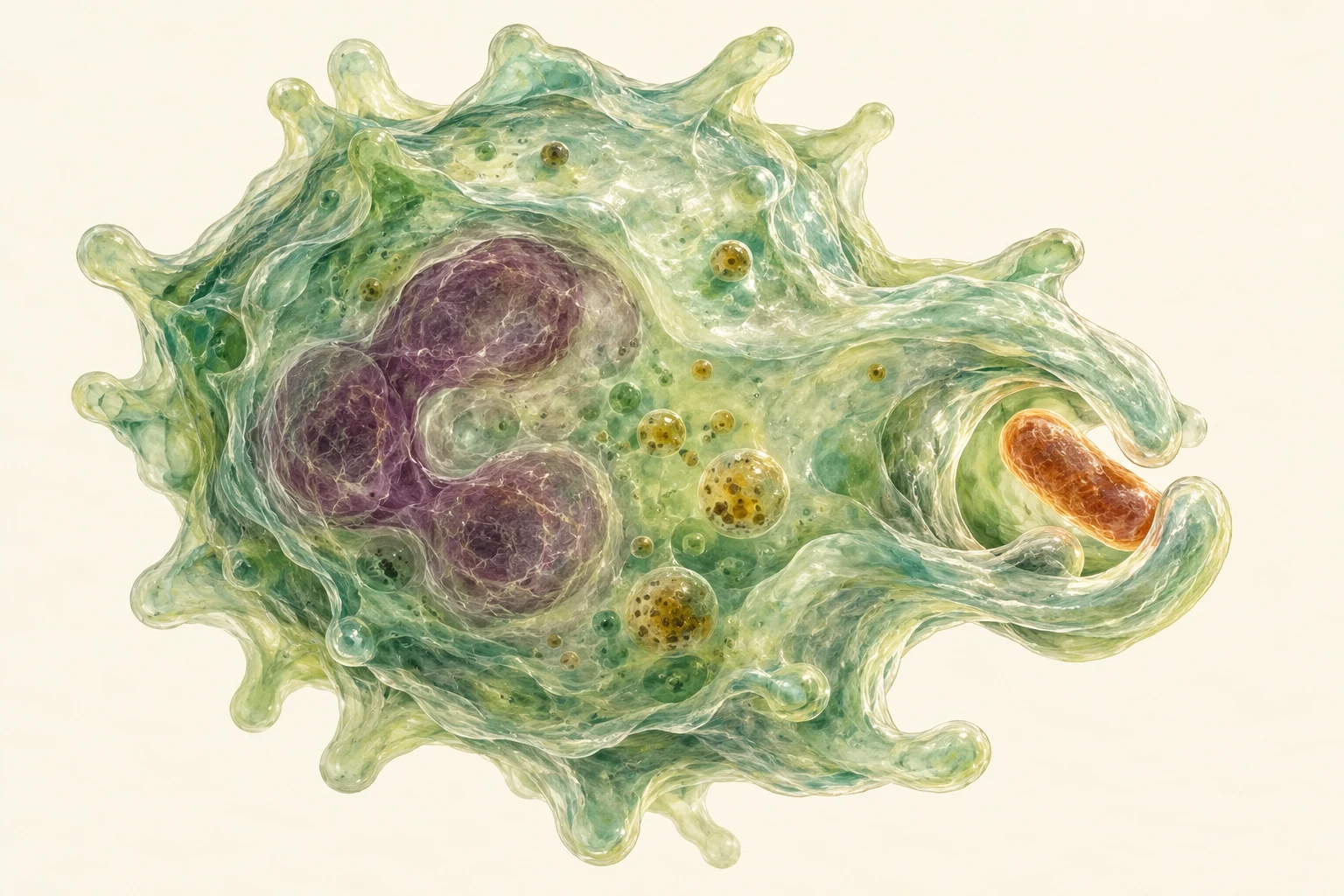
3. Outline phagocytosis and the role of lysosomes.
A phagocyte recognises and engulfs material into a vesicle. Fusion with enzyme-containing lysosomes supports its breakdown. Some antigen-presenting cells can then display antigen-derived fragments to lymphocytes, connecting uptake with a specific adaptive response.
4. Why is antigen presentation useful in activating helper T cells?
An antigen-presenting cell displays antigen-derived material with suitable surface molecules. A helper T cell with a matching receptor can recognise the presented material and, with the necessary signals, become activated. Recognition is a specific interaction, not every T cell responding equally to every antigen.
5. What do clonal selection and clonal expansion describe?
A lymphocyte with a receptor suited to an antigen is selected for activation. It then divides to produce a population of related cells with that specificity. The antigen does not instruct every lymphocyte to invent a new matching receptor after contact.
6. How do plasma cells and memory B cells differ?
Plasma cells are differentiated B cells that secrete antibodies. Memory B cells can persist and contribute to a faster response after later exposure to the antigen. A memory cell is not simply an antibody stored in the blood.
7. How does antibody structure contribute to specificity?
The variable regions form binding sites whose shape and chemical properties permit binding to a suitable antigenic structure. Antibodies also have regions that interact with other immune components. Binding specificity and the subsequent response are related but different parts of their function.
8. How can antibodies help remove a pathogen without themselves engulfing it?
They can bind antigens, neutralise interactions such as toxin or attachment activity, promote aggregation, and help other immune components recognise targets. Phagocytes perform engulfment. Antibodies are proteins, not cells that consume pathogens.
9. How does a cytotoxic T-cell response differ from antibody secretion?
Cytotoxic T cells recognise suitable antigen presentation on target cells and can induce their death. This helps control cells carrying intracellular pathogens. Plasma cells instead secrete antibodies that act on accessible antigenic material; these are distinct response mechanisms.
10. Why can a secondary immune response be faster than a primary response?
Memory cells with relevant specificity can persist after the first response. On later exposure they can contribute to more rapid expansion and effector activity. The response depends on the antigen and immune conditions; immune memory does not mean every infection is prevented.
11. How can vaccination produce active immunity?
Antigen exposure can stimulate the person’s own adaptive response and memory without requiring the same disease process as uncontrolled infection. This is active immunity because the immune system generates the response. Transfer of ready-made antibodies is passive immunity and does not itself establish the same memory.
12. Why can reduced transmission protect some people who are not individually immune?
If fewer susceptible transmission opportunities remain, an infectious agent may spread less readily through the population. The size of this effect depends on factors such as contact patterns and the protection against transmission. It is a population process rather than antibodies passing automatically between neighbours.
Original recall material. AQA specification · OCR A specification resources.