What you’ll learn
- Identify coding and template strands using their direction.
- Explain eukaryotic RNA processing and nuclear export.
- Use a supplied genetic code to predict a polypeptide and a mutation’s possible effect.
Connections: AQA 3.1.5, 3.4.2 · OCR A 2.1.3, 6.1.1. A nuclear gene in a eukaryotic cell is the main model. AQA includes splicing in 3.4.2; OCR post-transcriptional control connects to 6.1.1. Full replication, gene regulation and DNA technology are separate topics.
In this chapter
DNA strands and base pairing
A DNA nucleotide contains deoxyribose, phosphate and a base. Adjacent nucleotides are joined by phosphodiester bonds in each strand’s backbone. Complementary bases pair across the two strands through hydrogen bonds: A with T and G with C. The strands run antiparallel, so their 5′ and 3′ directions are opposite.
For a particular gene, RNA polymerase uses one strand as the template. The coding strand has the same base sequence as the RNA over the corresponding retained region, with T in DNA where RNA has U. The template is complementary to that sequence. Which strand serves as a template depends on the gene; “the top strand” is not a biological definition.
Transcription
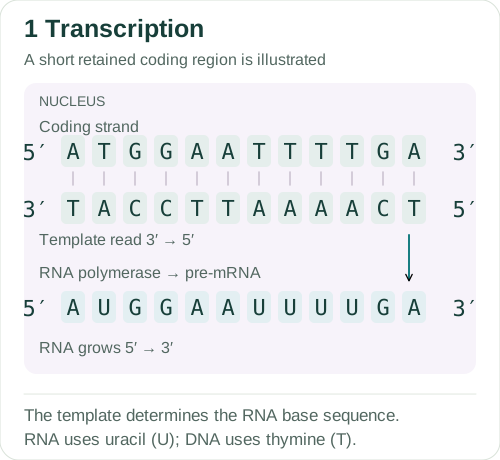
RNA polymerase reads the DNA template in the 3′ to 5′ direction and joins RNA nucleotides into a strand growing 5′ to 3′. Complementary pairing uses A–U and G–C. The DNA template remains available; transcription does not replace it with RNA. For a nuclear protein-coding gene in the model here, the initial transcript is pre-mRNA.
The diagram uses a short example coding region and leaves out the intron sequence. It shows only part of a gene. A sequence question may show the template in either direction. If it is written 5′ to 3′, constructing an RNA answer written 5′ to 3′ requires the reverse complement, not just replacing each letter in place.
About this diagram
Invented retained coding fragment in a eukaryotic nuclear-gene model, not a complete gene. The intron sequence is not included. Full polymerase structure, initiation and termination machinery are omitted.
Splicing and mRNA export
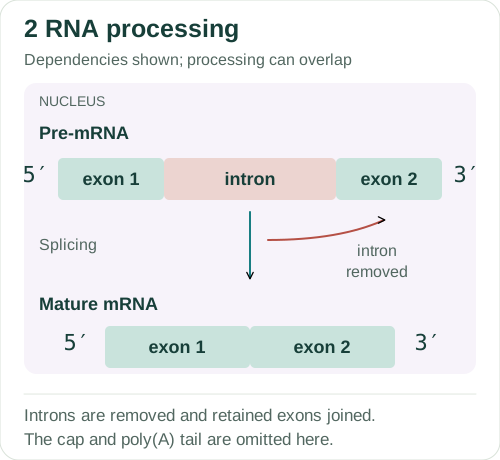
Splicing removes introns from pre-mRNA and joins the retained exons. Exons are the retained regions; they are not necessarily entirely protein-coding because untranslated regions can also be retained. Many eukaryotic mRNAs also receive a 5′ cap and a poly(A) tail, which support stability and later use of the transcript. These features are omitted from the simplified drawing.
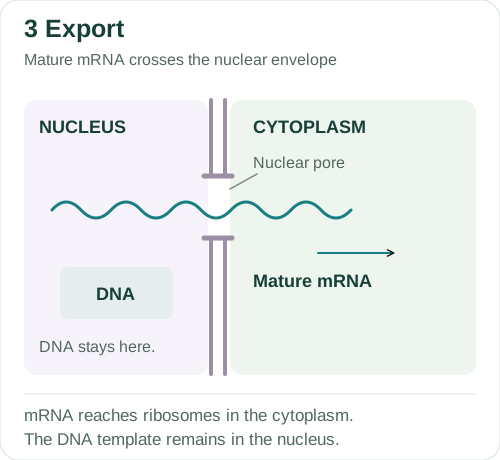
RNA processing can begin while transcription is still occurring. The numbered diagrams show the order of the main steps, although some of them can overlap. Mature mRNA crosses the nuclear envelope through a nuclear pore to reach cytoplasmic ribosomes. The nuclear DNA template stays in the nucleus in this route.
About this diagram
Selected intron removal and exon joining. Exons can include untranslated regions. The cap and poly(A) tail are omitted, and processing can overlap with transcription.
About this diagram
Selected mature-mRNA route through a nuclear pore. The nuclear envelope is a double membrane; export machinery is omitted. This model concerns a nuclear gene, not bacterial or organelle gene expression.
Translation
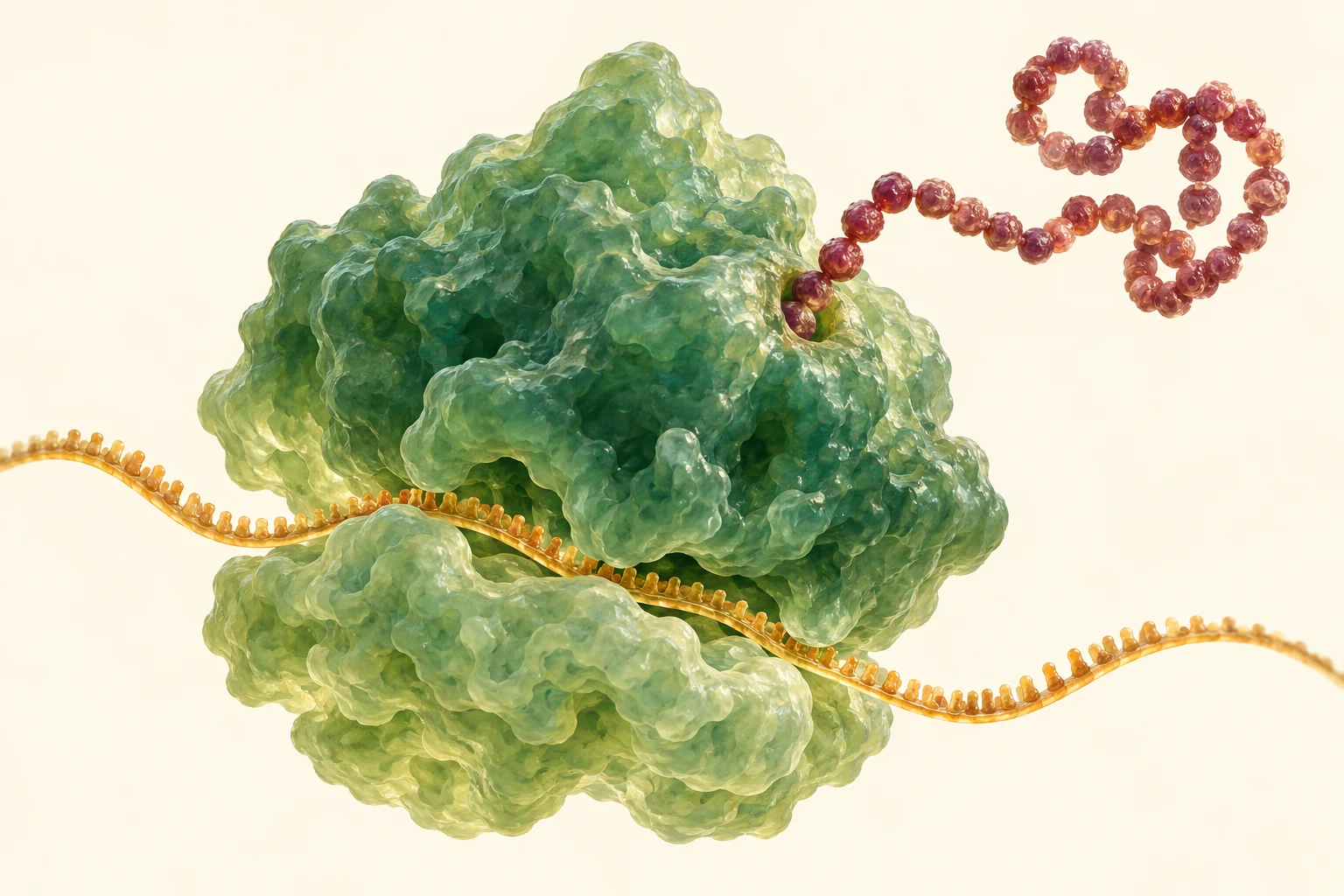
A ribosome reads mRNA codons in the 5′ to 3′ direction. A tRNA carries an amino acid and has an anticodon that pairs with a suitable codon. The pairing is complementary and antiparallel. Enzymes use ATP to attach the appropriate amino acid to its tRNA; charging and codon recognition are distinct parts of getting the sequence right.
The ribosome supports peptide-bond formation as the chain extends, and translation also uses GTP in steps not drawn here. In the standard genetic code used for the example, AUG specifies methionine and can initiate translation. A release factor recognises a stop codon and allows the polypeptide to be released. A stop codon has no corresponding normal amino-acid-carrying tRNA. The newly made polypeptide can then fold and undergo further processing; its sequence alone is not a diagram of its final functional shape.
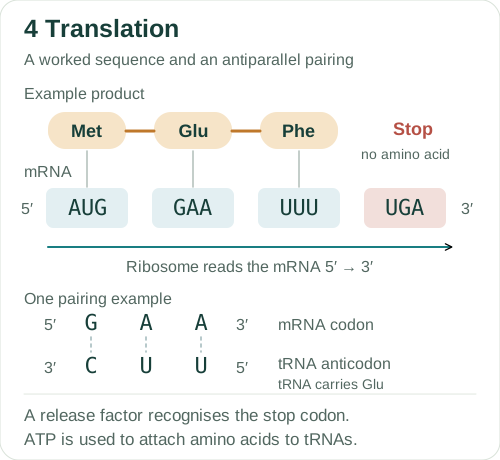
About this diagram
Invented short standard-code example. A selected codon–anticodon pair is shown; complete ribosome sites, tRNA charging and GTP use are omitted. Stop signals recruit release factors rather than an amino-acid-bearing tRNA.
The effects of a mutation
The code is degenerate: more than one codon can specify the same amino acid. A substitution can therefore be synonymous, change an amino acid or introduce a stop signal. A changed amino acid may alter interactions and folding, but the effect depends on its position and chemistry. A sequence change does not automatically destroy a protein’s function.
An insertion or deletion within a coding sequence can shift the reading frame when the number of bases is not a multiple of three. This can change downstream codons and introduce an early stop. Changes in splice sites or regulatory regions can instead affect processing or expression. Identify where the change occurs before applying a rule about reading frames.
Worked examples
1. Transcribe a supplied template
A DNA template fragment is written 3′ TAC CTT AAA ACT 5′. Write the RNA 5′ to 3′.
- The template is already oriented 3′ to 5′ from left to right.
- Pair T→A, A→U, C→G and G→C.
- Retain the stated left-to-right reading order.
The RNA is 5′ AUG GAA UUU UGA 3′.
The answer is complementary to the template and has the same sense as the corresponding coding strand. RNA uses U, so a transcript containing T needs correction.
2. Use the supplied code
For the example, use AUG = Met, GAA = Glu, UUU = Phe and UGA = stop. Translate 5′ AUG GAA UUU UGA 3′.
- Read the codons in the stated 5′ to 3′ direction.
- Add Met, then Glu, then Phe.
- Treat UGA as termination, not a fourth amino acid.
The illustrated product is Met–Glu–Phe, followed by termination.
The supplied codon meanings let you translate the sequence without memorising entries from a genetic-code table. The stop signal releases the chain; it adds no amino acid.
3. Interpret a synonymous change
A coding-region substitution changes a GAA codon to GAG. The supplied code assigns both to glutamate. Predict the direct effect on amino-acid sequence.
- Use the supplied code rather than assuming every base change changes an amino acid.
- Both codons specify Glu in the standard code.
There is no direct amino-acid substitution at that position.
Both codons specify the same amino acid, so this substitution leaves the polypeptide sequence unchanged. The example gives no information about possible effects on RNA processing, stability or expression.
These are original teaching examples, not reproduced exam questions or an official mark scheme.
Common errors
The coding strand is copied directly into RNA.
RNA polymerase uses the complementary template strand.
DNA leaves the nucleus for translation.
Mature mRNA is exported in this nuclear-gene model.
A stop codon adds a “stop amino acid”.
It signals termination and release of the polypeptide.
Every base substitution changes protein function.
The code and the position of the change determine its possible consequences.
Check your understanding
Try the questions before opening the answers.
1. Which anticodon pairs antiparallel with 5′ GAA 3′?
An anticodon written 3′ CUU 5′ pairs with it. If written in its own 5′ to 3′ direction, that anticodon sequence is UUC.
2. Which bonds join nucleotides along one DNA strand?
Phosphodiester bonds in the sugar–phosphate backbone. Hydrogen bonds link complementary bases across the two strands.
3. Why is “exons are always coding sequences” inaccurate?
Exons are regions retained in mature RNA, and they can include untranslated regions as well as coding sequence.
Practice for this topic
Connect this topic to an AQA essay title · Use official papers and mark schemes
Glossary
- Template strand
- DNA strand read by RNA polymerase for a particular transcript.
- Codon
- A three-base mRNA unit specifying an amino acid or termination in the reading frame.
- Anticodon
- A tRNA base triplet that pairs with a suitable mRNA codon.
References
References used for the explanations and diagrams, checked on 4 October 2026. The diagrams are schematics and are not to scale. Open “About this diagram” for the assumptions and details left out.