Six tasks · AQA 3.4.2 · OCR A 2.1.3

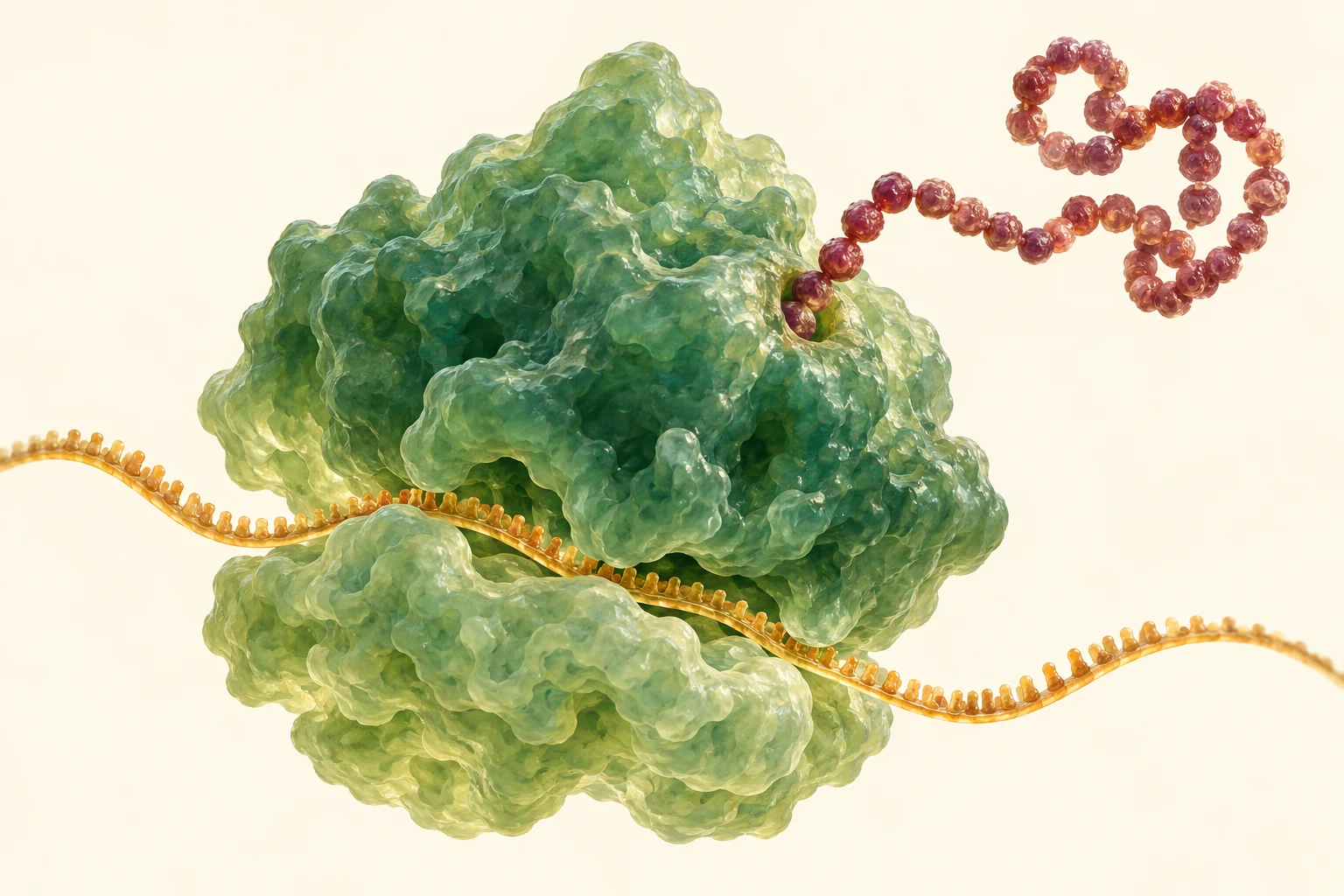
Protein synthesis: follow the information

Trace a eukaryotic gene from a nuclear transcript to a polypeptide, then explain where a disrupted step changes the outcome.

Browse all tasks and explanations ↓

Sequence, connect, explain

Two ordering chains, two missing links and two written explanations. Say or write your explanation before revealing the example.

All tasks and explanations

1. Order this simplified route from a eukaryotic gene to a mature mRNA reaching a ribosome. Transcription and RNA processing can overlap; this chain shows dependencies, not every molecular event.

Model steps and explanation
  1. RNA polymerase uses an exposed DNA template strand in the nucleus.
  2. Complementary RNA nucleotides are joined to form a pre-mRNA transcript.
  3. Introns are removed and the retained exons joined during splicing.
  4. The mature mRNA is exported from the nucleus.
  5. A ribosome associates with the mRNA for translation.

The DNA template determines the transcript sequence. A eukaryotic protein-coding transcript is processed, including splicing, before the mature mRNA is translated by cytoplasmic ribosomes. This is a simplified information route; processing can begin while transcription continues.

Do not place translation in the nucleus or say that DNA leaves through a nuclear pore.

2. Arrange these dependencies for adding one amino acid during translation. The chain begins with a tRNA that is not yet carrying its amino acid.

Model steps and explanation
  1. The appropriate amino acid is attached to a tRNA, using ATP-dependent charging.
  2. The charged tRNA pairs its anticodon with the matching mRNA codon at the ribosome.
  3. A peptide bond joins the new amino acid to the growing chain.
  4. The ribosome advances along the mRNA to the next codon.
  5. A subsequent matching charged tRNA can bind for the next addition.

Charging supplies the correct amino acid on a tRNA. Complementary codon–anticodon pairing positions it, and the ribosome supports peptide-bond formation. Movement then exposes the next codon. Several ribosomes may translate the same mRNA; this task follows one elongation cycle.

The anticodon is on tRNA. The codon is on mRNA, not on the amino acid.

3. A transcript contains both introns and exons. Before it becomes the mature mRNA in this example, which link is needed?

  • Join amino acids to the DNA backbone.
  • Remove introns and join the retained exons.
  • Replace every uracil with thymine.
  • Duplicate the entire chromosome.
Explanation and feedback

Correct link: Remove introns and join the retained exons.

Splicing removes introns and joins exons in the RNA transcript. Translation reads the resulting mRNA codons. DNA replication and RNA processing are different processes.

A transcript is not converted back into DNA by replacing uracil.

4. A stop codon enters the ribosome. Which link explains termination of translation?

  • A tRNA carrying a special stop amino acid is added.
  • RNA polymerase begins copying the polypeptide.
  • A release factor recognises the stop signal and the polypeptide is released.
  • The ribosome converts all remaining codons to DNA.
Explanation and feedback

Correct link: A release factor recognises the stop signal and the polypeptide is released.

A stop codon is a termination signal. Release factors allow the completed polypeptide to be released; it does not encode an additional stop amino acid.

Do not treat a stop codon as an ordinary amino-acid codon.

5. A base substitution changes a codon, but the polypeptide sequence stays the same. Explain how this is possible.

Explanation and feedback

The genetic code is degenerate: different codons can specify the same amino acid. If the altered codon still specifies that amino acid, translation produces the same amino-acid sequence at that position. This does not establish that every base substitution is harmless.

A change in DNA sequence does not automatically mean a change in amino-acid sequence.

  • Different codons can specify the same amino acid.
  • The original and altered codons specify the same amino acid in this example.
  • The explanation is conditional, rather than claiming that all substitutions leave proteins unchanged.

6. A treatment prevents a ribosome from advancing along mRNA after peptide-bond formation. Explain why normal elongation would fail, even if charged tRNAs are available.

Explanation and feedback

The ribosome must move to present the next codon in the appropriate position for another charged tRNA. Without that movement, the next codon–anticodon pairing and addition cannot proceed normally. Supplying charged tRNA does not replace the positional role of the ribosome.

Do not describe this as a direct failure of transcription or amino-acid synthesis.

  • Ribosome movement presents the next codon for translation.
  • Failure to advance prevents normal subsequent tRNA positioning and amino-acid addition.
  • Charged tRNA availability is distinguished from the ribosome’s movement and positioning.

Original selective revision practice. Full requirements: AQA specification · OCR A specification.