All prompts and explanations
1. How are the two strands of a DNA double helix held together?
Complementary bases on opposite strands form hydrogen bonds: A pairs with T and C with G. Within each strand, phosphodiester bonds join the sugar–phosphate backbone. These are different bonds with different roles; base pairing is not what covalently links adjacent nucleotides along one strand.
2. How is a gene related to a polypeptide’s amino-acid sequence?
For a protein-coding gene, the DNA base sequence supplies information that is transcribed and then translated. Successive codons specify amino acids or a stop signal. Some genes instead produce functional RNA, so not every gene has a polypeptide as its final product.
3. What does semi-conservative DNA replication mean?
Each resulting DNA molecule contains one strand from the original molecule and one newly made complementary strand. The original strands separate and act as templates. It does not mean that each strand is a random mixture of equal amounts of old and new nucleotides.
4. What distinct roles do helicase and DNA polymerase have in replication?
Helicase helps separate the strands by disrupting the interactions between paired bases. DNA polymerase adds nucleotides to a growing complementary strand and forms phosphodiester links. Polymerase synthesises in the 5′ to 3′ direction and requires a suitable starting end.
5. Describe transcription of a protein-coding gene.
RNA polymerase uses one DNA strand as a template and joins complementary RNA nucleotides. The RNA has U where a complementary RNA base pairs with DNA A. Transcription makes RNA; it does not join amino acids or use a ribosome to make a polypeptide.
6. How does the coding DNA strand relate to the mRNA sequence?
When both are written in the corresponding 5′ to 3′ direction, the coding-strand sequence matches the mRNA sequence except that DNA T is replaced by RNA U. The template strand is complementary and antiparallel to the RNA. Always check which strand and direction are supplied.
7. Why can a eukaryotic primary RNA transcript differ from mature mRNA?
Introns can be removed and exons joined during RNA processing. Other modifications, such as a cap and poly-A tail, can also occur. The ribosome translates the mature coding sequence, so directly translating every base of a genomic gene can give an incorrect prediction.
8. What do “degenerate” and “non-overlapping” mean for the genetic code?
Degenerate means that more than one codon can specify the same amino acid. Non-overlapping means that, in a given reading frame, each base belongs to one codon. Degeneracy does not mean that one codon normally specifies several different amino acids.
9. How does tRNA connect a codon with an amino acid?
A tRNA carries an amino acid and has an anticodon that can pair with an appropriate mRNA codon. Enzymes load tRNAs with the correct amino acids. The anticodon and the attached amino acid have different roles in connecting nucleotide information to a polypeptide sequence.
10. What happens as a ribosome translates mRNA?
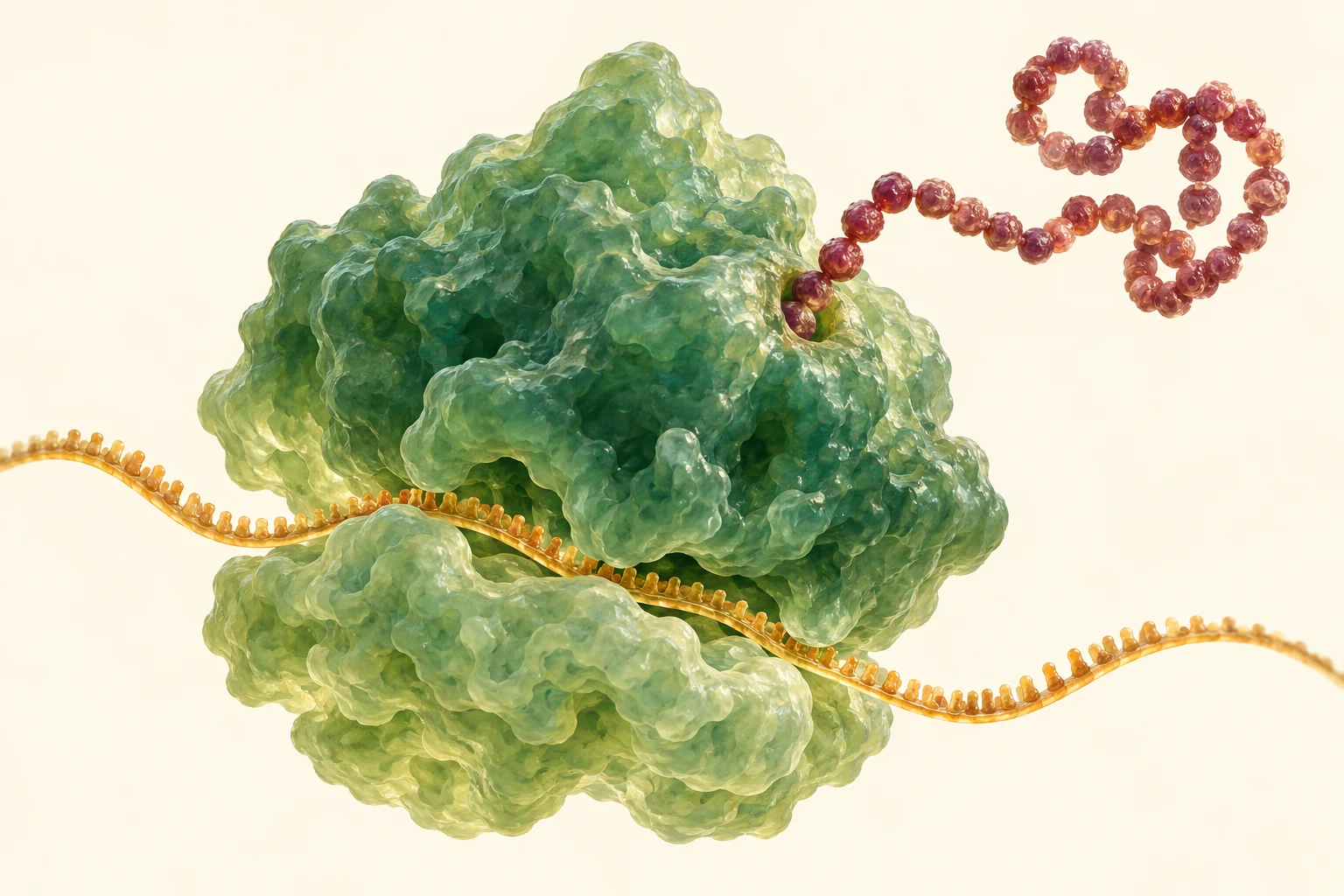
The ribosome positions mRNA and tRNAs so that codon–anticodon pairing helps select amino acids. Peptide bonds join the growing chain, and the ribosome advances along the message. A stop codon leads to termination rather than specifying an extra amino acid.
11. Why does a base substitution not always change the final protein’s function?
It may leave the amino acid unchanged because the code is degenerate, affect a non-coding region, or change an amino acid without materially altering the protein’s behaviour. Other substitutions can be harmful or beneficial. The location and molecular consequence must be considered.
12. Why can a single-base insertion have a large effect in a coding sequence?
An insertion within the translated reading frame can change the grouping of subsequent bases into codons. This can alter many downstream amino acids or introduce a stop signal. Inserting three bases can have a different effect because it need not shift the downstream reading frame.
Original recall material. AQA specification · OCR A specification resources.