All prompts and explanations
1. Where does glycolysis occur, and what does it produce from one glucose?
It occurs in the cytoplasm. One glucose is converted to two pyruvate molecules, with a net gain of two ATP and reduction of NAD. Glycolysis itself does not directly consume oxygen.
2. Why is glycolysis described as having a net ATP gain?
ATP is used in early phosphorylation steps and produced in later steps. The total ATP produced exceeds the amount used by two per glucose in the standard pathway. Reporting only the production ignores the initial investment.
3. What happens to pyruvate in the link reaction?
In a eukaryotic cell, the reaction occurs in the mitochondrial matrix. Pyruvate loses carbon dioxide and is oxidised while NAD is reduced. The remaining two-carbon acetyl group combines with coenzyme A to form acetyl-CoA.
4. What happens to an acetyl group entering the Krebs cycle?
It combines with a four-carbon acceptor to form a six-carbon compound. Subsequent reactions release carbon dioxide, reduce NAD and FAD, produce a small amount of ATP or an equivalent energy carrier, and regenerate the four-carbon acceptor.
5. Why are reduced NAD and reduced FAD important for aerobic ATP production?
They transfer electrons derived from earlier oxidation reactions to the electron-transport system. Oxidation of these coenzymes enables electron transfer coupled to proton movement. They are recycled rather than being permanently used up.
6. Where is the mitochondrial electron-transport system located?
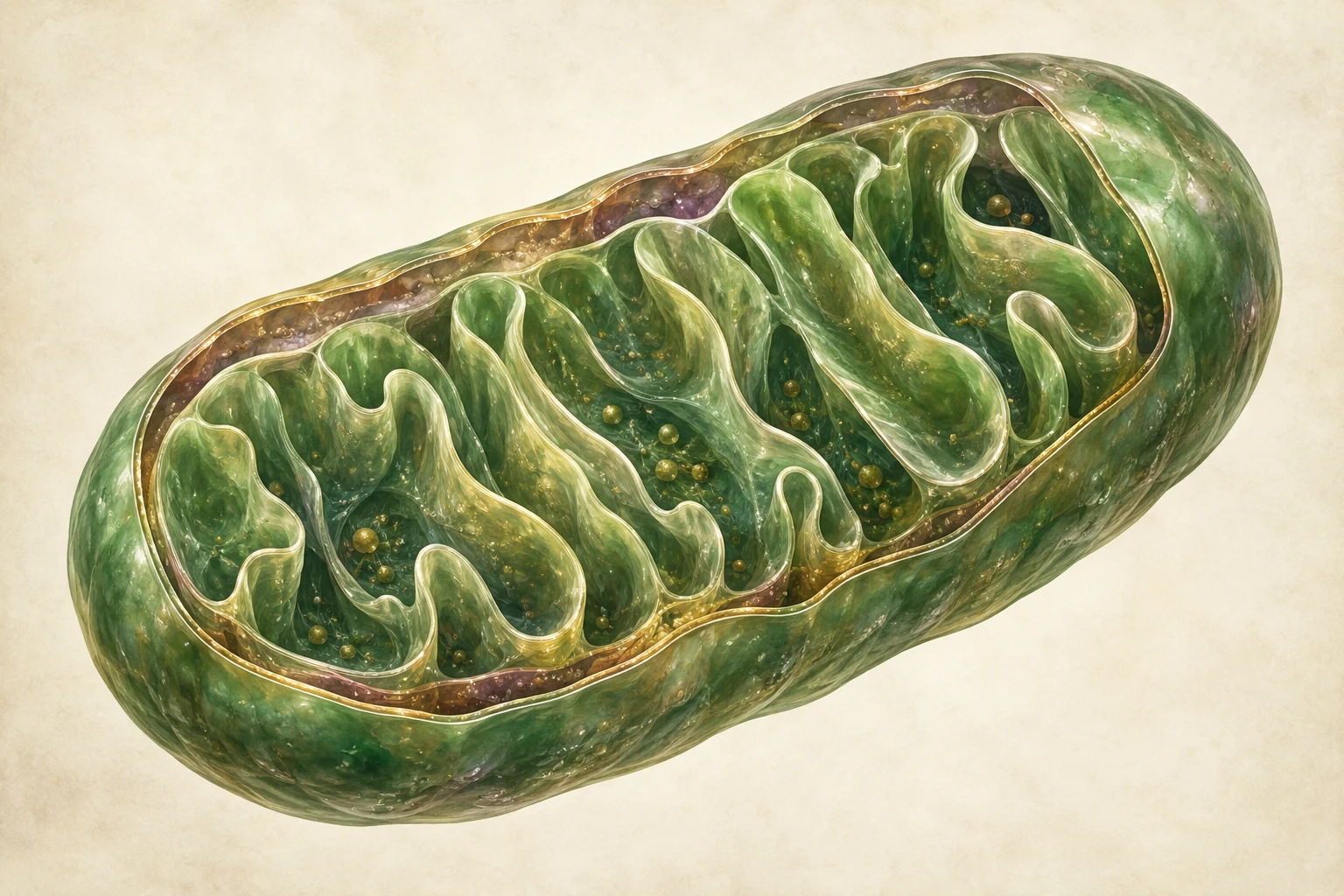
It is in the inner mitochondrial membrane. That membrane separates the matrix from the intermembrane space, allowing an electrochemical proton gradient to be maintained. Its folds increase membrane area for the associated machinery.
7. Explain oxidative phosphorylation through chemiosmosis.
Electron transfer is coupled to proton movement from the matrix towards the intermembrane space. Protons return down their electrochemical gradient through ATP synthase, driving ATP formation from ADP and inorganic phosphate. This couples oxidation to phosphorylation.
8. What is oxygen’s role at the end of the electron-transport chain?
Oxygen accepts electrons at the terminal stage and combines with protons to form water. Without a suitable terminal acceptor, continued electron flow and recycling of reduced coenzymes are restricted. Oxygen is not directly consumed in glycolysis.
9. What is substrate-level phosphorylation?
ATP is formed by transferring a phosphate group from a phosphorylated substrate to ADP. It does not require a proton gradient across a membrane. It occurs in glycolysis and in a reaction of the Krebs cycle.
10. How does lactate formation help sustain glycolysis without sufficient oxygen?
Pyruvate is reduced to lactate while reduced NAD is oxidised back to NAD. Regenerated NAD can accept electrons in glycolysis. Lactate formation does not itself supply the large ATP yield associated with aerobic oxidative phosphorylation.
11. How does the yeast anaerobic pathway regenerate NAD?
Pyruvate is decarboxylated to form an intermediate that is reduced to ethanol. Carbon dioxide is released, and reduced NAD is oxidised back to NAD during ethanol formation. This allows glycolysis to continue supplying a small net ATP yield.
12. Define respiratory quotient and give one limitation of its interpretation.
RQ is carbon dioxide produced divided by oxygen consumed over a comparable interval and under comparable conditions. It can help interpret metabolism, but mixed substrates, physiological state and experimental conditions can affect the value. It does not alone prove that one fuel was used exclusively.
Original recall material. AQA specification · OCR A specification resources.