All prompts and explanations
1. What does a biological catalyst change about a reaction?
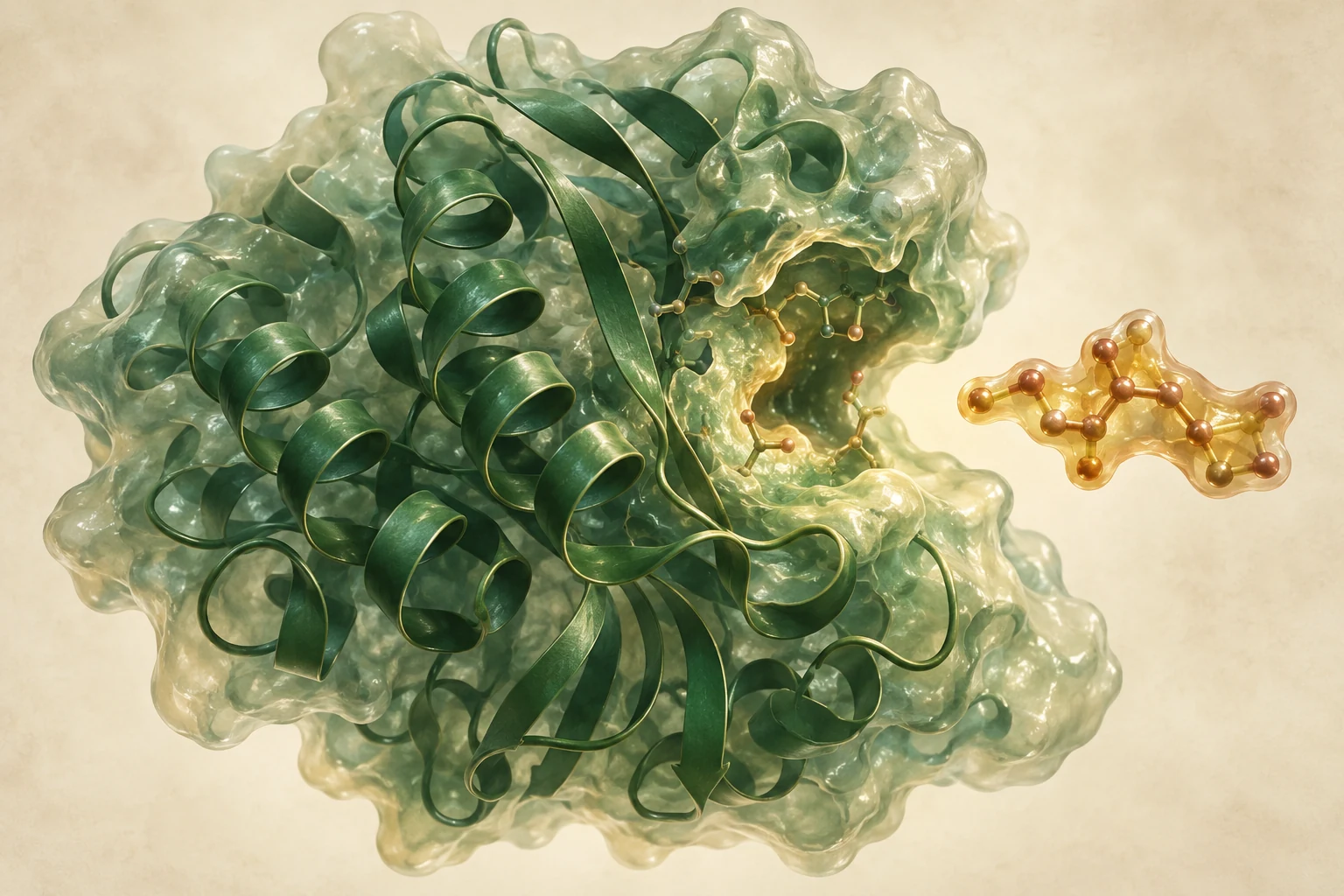
It increases the rate by providing a pathway with lower activation energy and is not consumed overall. It does not change the overall energy difference between reactants and products or make an unfavourable equilibrium favourable. Many enzymes are globular proteins.
2. Why is an enzyme’s active site selective?
Its shape and chemical properties allow suitable substrates to bind and interact. The folding of the enzyme positions particular groups in the active site. A change in structure can alter substrate binding or catalysis.
3. Describe induced fit.
Binding involves a change in enzyme conformation rather than a completely rigid fit. The resulting arrangement can favour the reaction, for example by positioning reactive groups or straining bonds. The active site is not simply a fixed mould.
4. Does an enzyme change the equilibrium position of a reaction?
No. It speeds the approach to equilibrium by catalysing the reaction pathway, without changing the equilibrium determined by the reaction’s energetics. A faster reaction is not automatically one with a different final equilibrium composition.
5. Why can rate level off as substrate concentration rises at fixed enzyme concentration?
At sufficiently high substrate concentration, the enzyme’s active sites are occupied much of the time. Enzyme availability limits further increases in rate under those conditions. Adding more substrate then has relatively little effect.
6. When can increasing enzyme concentration increase rate?
When sufficient substrate is available and other conditions are comparable, more enzyme provides more active sites for reactions. If substrate availability or another factor becomes limiting, the rate need not continue increasing in proportion.
7. Explain an initial increase and later decrease in rate as temperature rises.
Over a suitable range, more frequent effective collisions can increase rate. At sufficiently high temperatures, disruption of the enzyme’s structure can reduce catalysis. The temperature at which this occurs depends on the enzyme and experimental conditions.
8. Why can pH affect enzyme activity?
Changing hydrogen-ion concentration can alter charges and interactions in the enzyme or substrate. It can affect active-site binding and, in some cases, folding. Different enzymes have different pH ranges in which they function well.
9. How does a competitive inhibitor reduce activity?
In the standard model, it competes with substrate for the active site. Increasing substrate concentration can reduce the inhibitor’s effect because substrate is more likely to occupy the site. The statement depends on the competitive-inhibition model being applicable.
10. How does the simplified non-competitive inhibition model differ?
The inhibitor binds at a site other than the substrate-binding site and reduces catalytic activity. Increasing substrate concentration does not restore the same maximum rate in this model. Do not assume that every inhibitor acting elsewhere behaves identically.
11. Why might 1/time be used as a rate proxy?
When the same fixed endpoint and comparable starting conditions are used, a shorter time indicates a faster process. Its reciprocal increases as time decreases. The unit is inverse time, rather than a measured product volume per unit time.
12. In a pH investigation, name useful controlled variables and explain one.
Temperature, starting enzyme concentration, substrate concentration and total volume may need to be comparable. For example, a temperature difference could affect rate independently of pH, making the pH comparison harder to interpret.
Original recall material. AQA specification · OCR A specification resources.